Maritime operations no longer rely only on large, crewed vessels. More and more, they depend on uncrewed surface vessels (USVs) and autonomous underwater vehicles (AUVs) working together. When surface and subsea robotics are paired, navies and maritime operators can carry out Mine Countermeasures (MCM) and Rapid Environmental Assessment (REA) faster, more safely and with greater precision, while keeping people out of harm's way.
Dates
31 Aug – 25 Sep 2026
Area
Tróia & Sesimbra, Portugal
Systems
Mariner X USV - CORAX 600 AUV
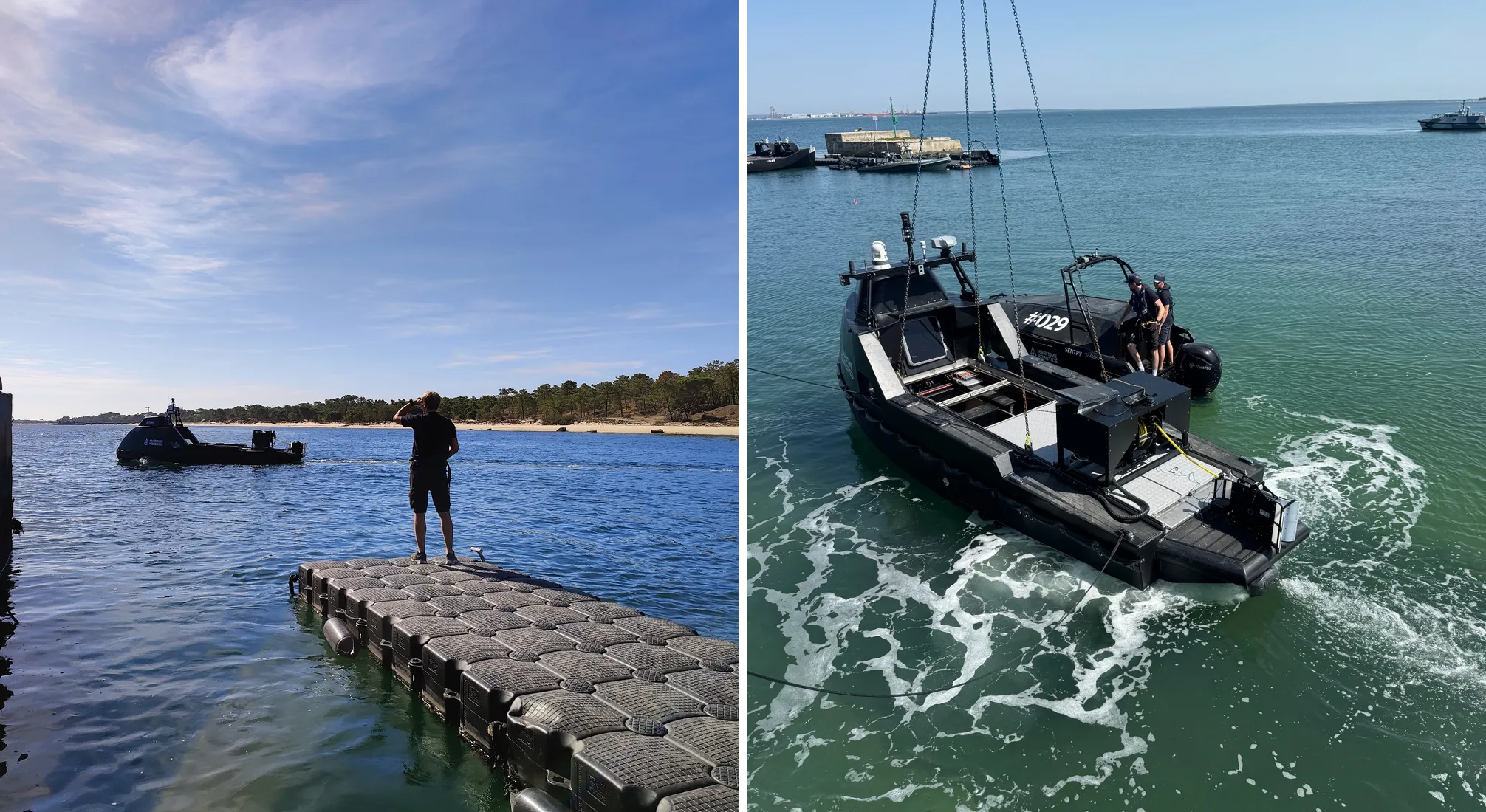
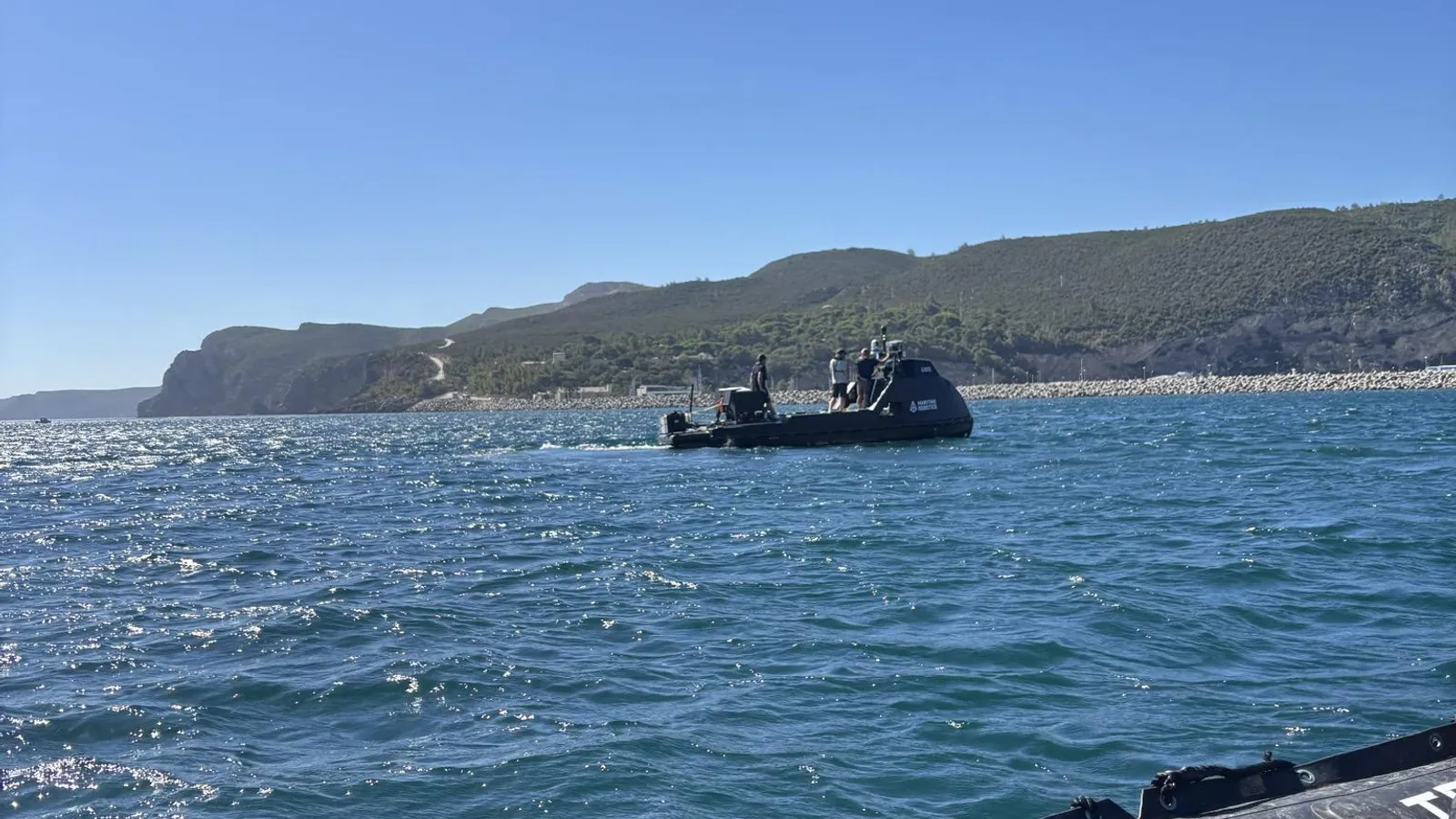
Fig. 1: Mariner X USV during REPMUS 2026. Images courtesy of Maritime Robotics.
During September, Maritime Robotics and Skarv Technologies put this into practice at NATO Exercise REPMUS in Portugal, running combined operations with Maritime Robotics' Mariner X USV and Skarv's CORAX 600 AUV. REPMUS (Robotic Experimentation and Prototyping With Maritime Unmanned Systems) runs from 31 August to 25 September 2026 out of Tróia and Sesimbra.
The exercise is led by the Portuguese Navy and co-organized with FEUP, NATO CMRE, NATO JCGMUS and EDA. It is the largest operational experimentation event of its kind. Recent editions have drawn several thousand participants from more than twenty nations and well over two hundred uncrewed air, surface and underwater systems.
The surface and subsea pair
Mariner X USV
Surface - Maritime Robotics
The Mariner X operates on the surface. It serves as a mobile command node, a communication bridge and a GNSS positioning reference for the vehicle below. The 9-metre vessel has a polyethylene hull and runs Maritime Robotics' Autonomous Navigation System, remotely or fully autonomously. Its back deck carries more than a tonne of payload, including AUV launch and recovery systems, and its fuel capacity supports missions of up to 25 days, depending on conditions.
CORAX 600 AUV
Subsea - Skarv Technologies
The CORAX 600 is built for the close-range end of the MCM problem. It is a hovering, six-thruster vehicle rated to 600 metres. It can hover and move in three dimensions next to a target and combines acoustic sidescan with high-resolution optical imaging. Detection, classification and photogrammetry can run on the vehicle itself, so the AUV sends contact reports rather than raw data.
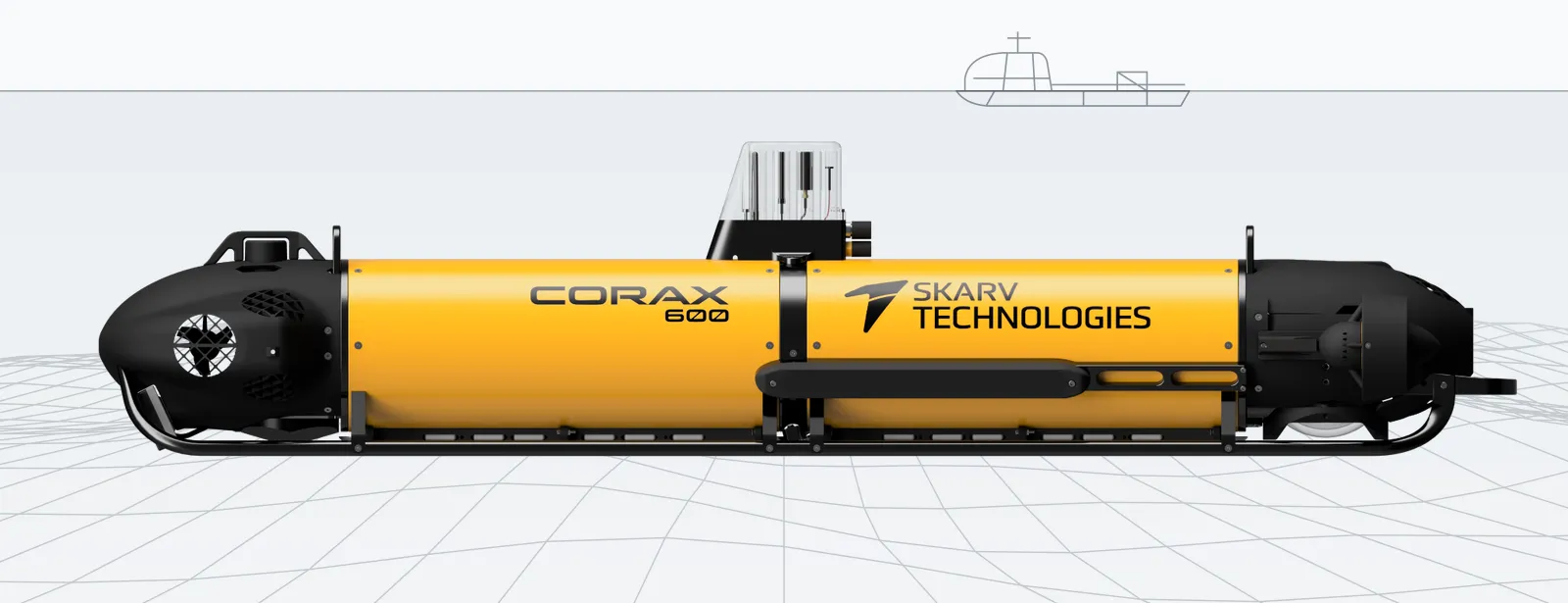
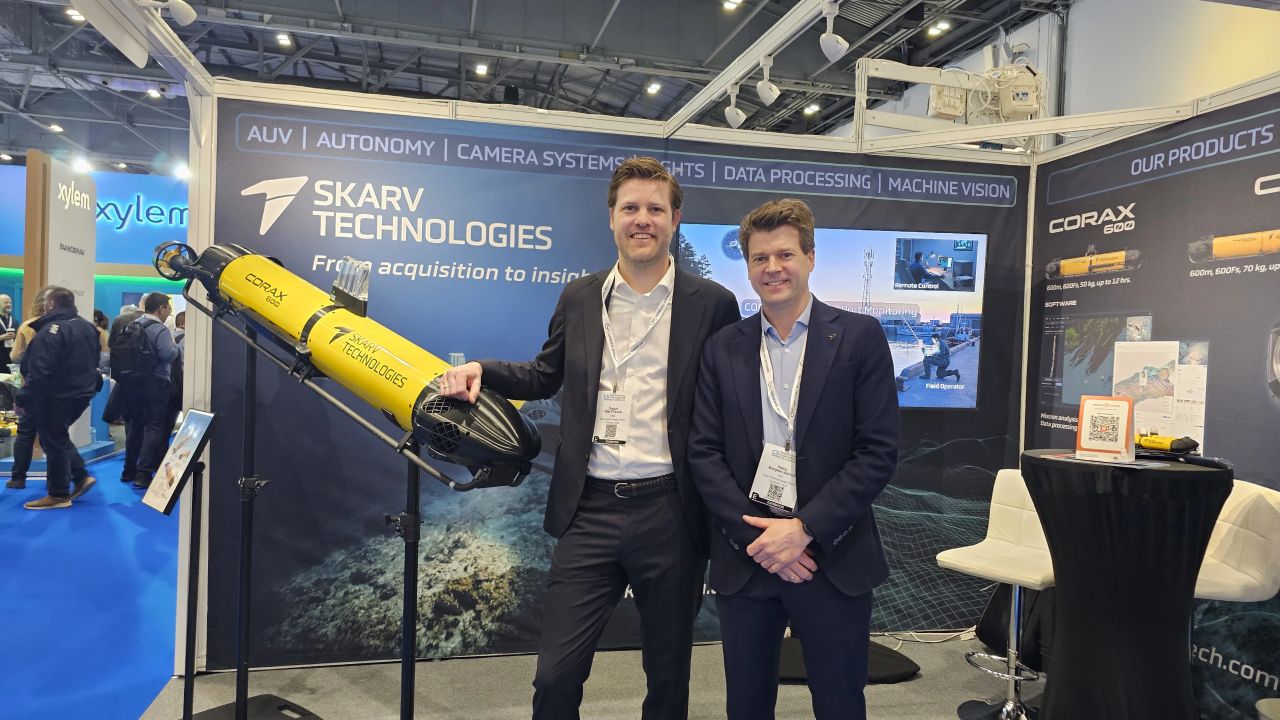
Fig. 2: The CORAX 600 AUV system. Image credit: Skarv Technologies 2026.
Solving the subsea communication barrier
Radio signals such as GNSS, Wi-Fi and LTE cannot penetrate water. This leaves underwater work with two standing constraints: navigation drift without GNSS, and a narrow acoustic link to the surface.
The Mariner X addresses both. It follows the survey pattern directly above the CORAX 600 and uses acoustic signals to continuously correct the AUV's position. At the same time, it relays status, contacts and re-tasking between the AUV and an operator ashore over its own LTE and satellite links.

Fig. 3: Communication chain. The USV corrects the AUV's position acoustically and relays status, contacts and re-tasking to shore.
What we demonstrated at REPMUS
The goal of the Norwegian operations was to show more efficient MCM operations, with the Mariner X supporting the CORAX 600 with positioning and remote communications.
The result is a fully uncrewed pair that can be trailered, containerised and launched from a small slipway. It needs no mother ship and puts no divers in the water near a suspected mine. The operations at REPMUS were successful and show the potential of coordinated surface and underwater operations.
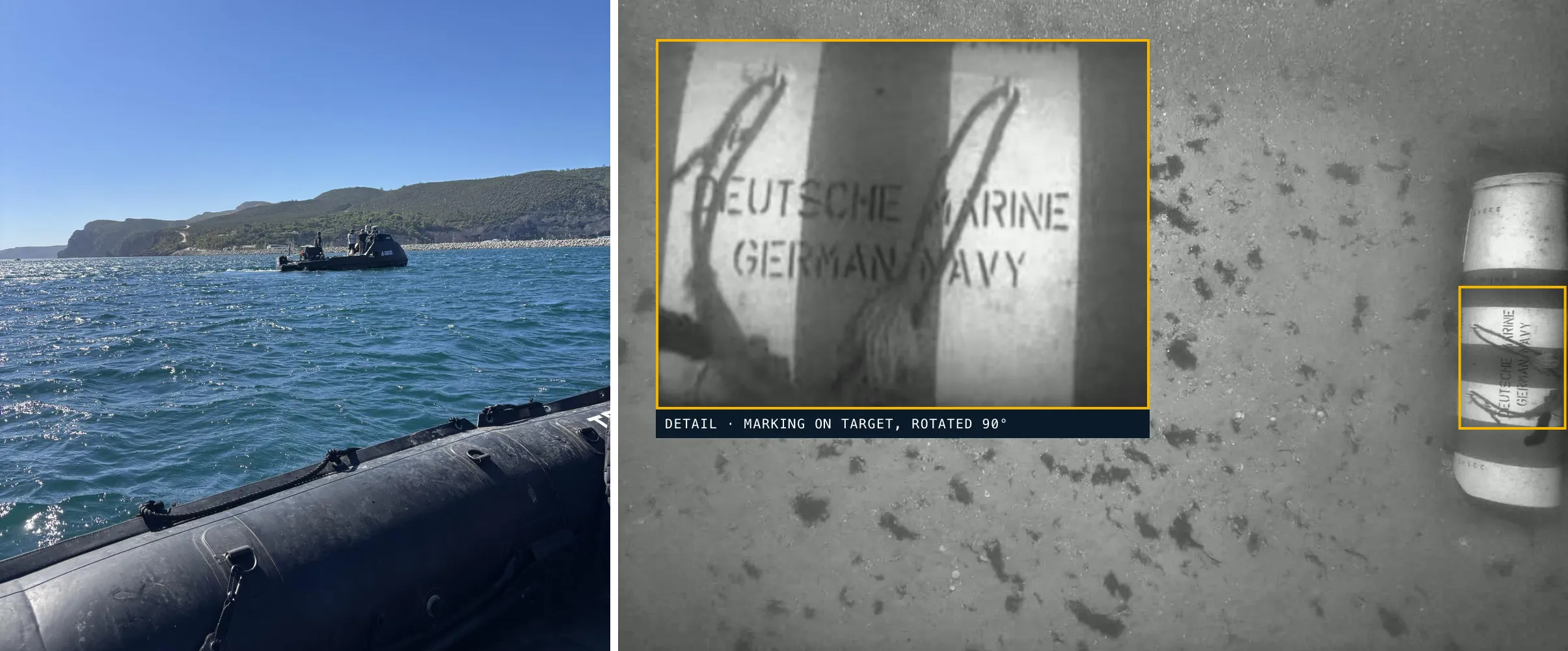
Fig. 4: Left: Mariner X USV on the water, following the CORAX 600 while the AUV runs a camera mission. Right: close-range optical image of a practice target on the seabed, with a detail of the marking on the object. The image is black and white because a monochrome camera sensor has higher light sensitivity, which suits low-light underwater conditions with high turbidity. Both images courtesy of Skarv Technologies.
Core applications: MCM and REA
Mine Countermeasures (MCM)
The CORAX 600 surveys the seabed with sidescan, then hovers next to possible contacts for close-range optical classification. The Mariner X streams the resulting contact reports to operators positioned safely outside the minefield.
Rapid Environmental Assessment (REA)
The same pair can map bathymetry and seabed conditions ahead of naval deployments or offshore infrastructure work such as offshore wind. The CORAX 600 collects sonar and optical imagery, and the Mariner X relays the results for immediate situational awareness.
Key operational advantages
A
Risk mitigation
No crew or divers need to be near a suspected hazard, and any crewed assets can stay at a safe distance.
B
Precision navigation
GNSS positioning from the surface vessel continuously updates the AUV over the acoustic link, giving accurate mapping and target positions.
C
Deployability and cost
A two-tonne surface vessel and a hovering 600-metre AUV can be deployed by a small team in a day, without a purpose-built vessel.
From Mongstad to Tróia
This is the second deployment of the combined system. Earlier this year, during the IXES exercise at Mongstad in June, the two companies carried out a multi-vehicle operation focused on surveillance and protection of the Mongstad refinery. The two deployments cover both ends of the same capability. At home, the system protects critical undersea and coastal infrastructure. In an allied exercise setting, it performs expeditionary mine countermeasures.
The timing matches a clear shift in allied thinking. The Royal Navy's First Sea Lord has set out a hybrid fleet in which networks of autonomous sensors extend the reach of crewed platforms. Belgium and the Netherlands took delivery of their first full rMCM toolbox in March 2026. Among these developments, the Mariner X and CORAX 600 pairing stands out for its scale and cost, and it shows how bridging surface connectivity with subsea data gathering can make maritime security smarter, safer and more scalable.
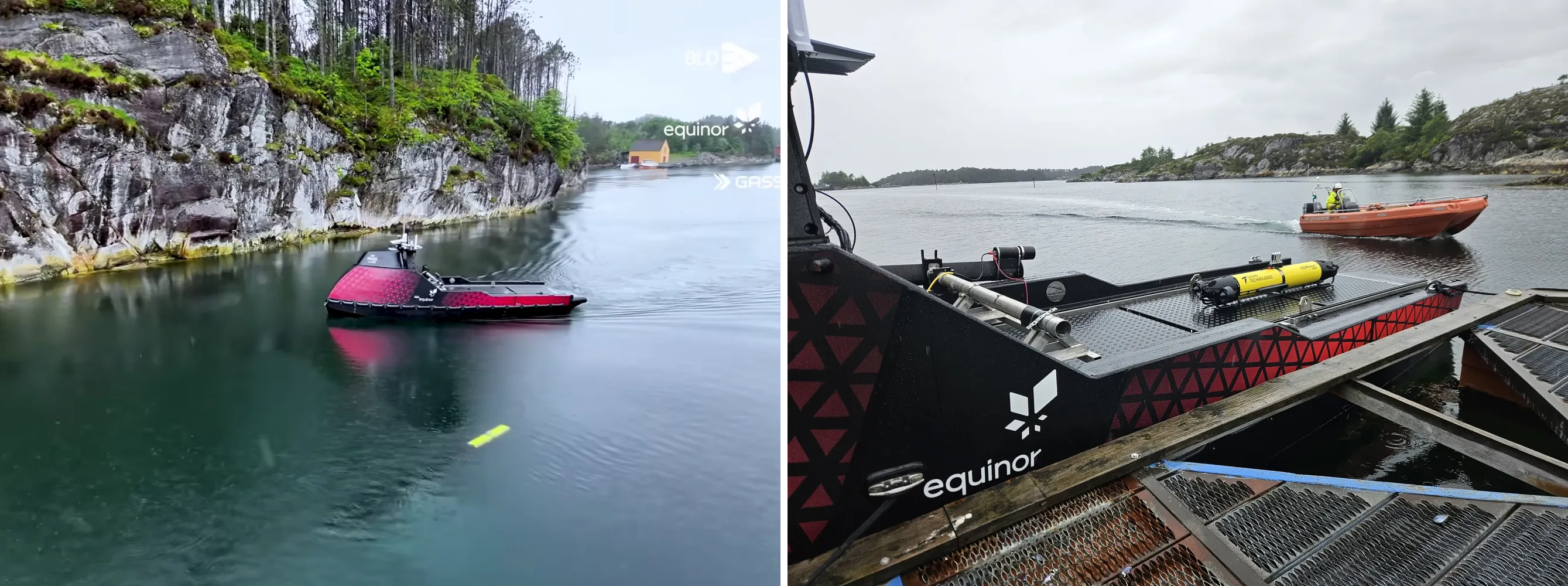
Fig. 5: Left: Mariner USV and CORAX 600 at the IXES exercise. Image credit: UAS Norway. Right: CORAX 600 on the deck of the Mariner USV at IXES. Image credit: Skarv Technologies.
About Skarv Technologies
Skarv Technologies AS designs and builds autonomous underwater vehicles in Trondheim, Norway. Its CORAX 600 AUV system comes in several models and sensor integrations, all based on a hovering, six-thruster design rated to 600 metres and made for close-range subsea work. Skarv also handles the data analysis for detection, classification and photogrammetry, as part of an end-to-end system that runs from vehicle to finished results. Skarv's customers work in defence and commercial maritime applications, and use CORAX for mine countermeasures, rapid environmental assessment and inspection of critical subsea infrastructure.
www.skarvtech.com
About Maritime Robotics AS
Since 2005, Maritime Robotics has been at the forefront of maritime autonomy, pioneering the development of advanced sea drones and autonomous maritime systems. At the core of its offering is a market-leading autonomous navigation platform enabling robust and reliable sea drone operations across mission-critical applications, serving dual-use customers globally.
www.maritimerobotics.com